Showing posts with label HDL. Show all posts

May 20, 2013

Sudden cholesterol increase? It may be psychological


There are many published studies with evidence that cholesterol levels are positively associated with heart disease. In multivariate analyses the effects are usually small, but they are still there. On the other hand, there is also plenty of evidence that cholesterol is beneficial in terms of health. Here of course I am referring to the health of humans, not of the many parasites that benefit from disease.

For example, there is evidence () that cholesterol levels are negatively associated with mortality (i.e., higher cholesterol leading to lower mortality), and are positively associated with vitamin D production from skin exposure to sunlight ().

Most of the debris accumulated in atheromas are made up of macrophages, which are specialized cells that “eat” cell debris (ironically) and some pathogens. The drug market is still hot for cholesterol-lowering drugs, often presented in TV and Internet ads as effective tools to prevent formation of atheromas.

But what about macrophages? What about calcium, another big component of atheromas? If drugs were to target macrophages for atheroma prevention, drug users may experience major muscle wasting and problems with adaptive immunity, as macrophages play a key role in muscle repair and antibody formation. If drugs were to target calcium, users may experience osteoporosis.

So cholesterol is the target, because there is a “link” between cholesterol and atheroma formation. There is also a link between the number of house fires in a city and the amount of firefighting activity in the city, but we don’t see mayors announcing initiatives to reduce the number of firefighters in their cities to prevent house fires.

When we talk about variations in cholesterol, we usually mean variations in cholesterol carried by LDL particles. That is because LDL cholesterol seems to be very “sensitive” to a number of factors, including diet and disease, presenting quite a lot of sudden variation in response to changes in those factors.

LDL particles seem to be intimately involved with disease, but do not be so quick to conclude that they cause disease. Something so widespread and with so many functions in the human body could not be primarily an agent of disease that needs to be countered with statins. That makes no sense.

Looking at the totally of evidence linking cholesterol with health, it seems that cholesterol is extremely important for the human body, particularly when it is under attack. So the increases in LDL cholesterol associated with various diseases, notably heart disease, may not be because cholesterol is causing disease, but rather because cholesterol is being used to cope with disease.

LDL particles, and their content (including cholesterol), may be used by the body to cope with conditions that themselves cause heart disease, and end up being blamed in the process. The lipid hypothesis may be a classic case of reverse causation. A case in point is that of cholesterol responses to stress, particularly mental stress.

Grundy and Griffin () studied the effects of academic final examinations on serum cholesterol levels in 2 groups of medical students in the winter and spring semesters (see table below). During control periods, average cholesterol levels in the two groups were approximately 213 and 216 mg/dl. During the final examination periods, average cholesterol levels were 248 and 240 mg/dl. These measures were for winter and spring, respectively.

Sudden cholesterol increase? It may be psychological

One could say that even the bigger increase from 213 to 248 is not that impressive in percentage terms, approximately 16 percent. However, HDL cholesterol does not go up significantly response to sustained (e.g., multi-day) stress, it actually goes down, so the increases reported can be safely assumed to be chiefly due to LDL cholesterol. For most people, LDL particles are the main carriers of cholesterol in the human body. Thus, in percentage terms, the increases in LDL cholesterol are about twice those reported for total cholesterol.

A 32-percent increase (16 x 2) in LDL cholesterol would not go unnoticed today. If one’s LDL cholesterol were to be normally 140 mg/dl, it would jump to 185 mg/dl with a 32-percent increase. It looks like the standard deviations were more than 30 in the study. (This is based on the standard errors reported, and assuming that the standard deviation equals the standard error multiplied by the square root of the sample size.) So we can guess that several people might go from 140 to 215 or more (this is LDL cholesterol, in mg/dl) in response to the stress from exams.

And the effects above were observed with young medical students, in response to the stress from exams. What about a middle-aged man or woman trying to cope with chronic mental stress for months or years, due to losing his or her job, while still having to provide for a family? Or someone who has just been promoted, and finds himself or herself overwhelmed with the new responsibilities?

Keep in mind that sustained dieting can be a major stressor for some people, particular when one gets to that point in the dieting process where he or she gets regularly into negative nitrogen balance (muscle loss). So you may have heard from people saying that, after months or years of successful dieting, their cholesterol levels are inexplicably going up. Well, this post provides one of many possible explanations for that.

The finding that cholesterol goes up with stress has been replicated many times. It has been known for a long time, with studies dating back to the 1950s. Wertlake and colleagues () observed an increase in average cholesterol levels from 214 to 238 (in mg/dl); also among medical students, in response to the mental and emotional stress of an examination week. A similar study to the one above.

Those enamored with the idea of standing up the whole day, thinking that this will make them healthy, should know that performing cognitively demanding tasks while standing up is a known stressor. It is often used in research where stress must be induced to create an experimental condition. Muldoon and colleagues () found that people performing a mental task while standing experienced an increase in serum cholesterol of approximately 22 points (in mg/dl).

What we are not adapted for is sitting down for long hours in very comfortable furniture (, ). But our anatomy clearly suggests adaptations for sitting down, particularly when engaging in activities that resemble tool-making, a hallmark of the human species. Among modern hunter-gatherers, tool-making is part of daily life, and typically it is much easier to accomplish sitting down than standing up.

Modern urbanites could be seen as engaging in activities that resemble tool-making when they produce things at work for internal or external customers, whether those things are tangible or intangible.

So, stress is associated with cholesterol levels, and particularly with LDL cholesterol levels. Diehard lipid hypothesis proponents may argue that this is how stress is associated with heart disease: stress increases cholesterol which increases heart disease. Others may argue that one of the reasons why LDL cholesterol levels are sometimes found to be associated with heart disease, such as stress, and other health conditions is that the body is using LDL cholesterol to cope with those conditions.

Specifically regarding mental stress, a third argument has been put forth by Patterson and colleagues, who claimed that stress-mediated variations in blood lipid concentrations are a secondary result of decreased plasma volume. The cause, in their interpretation, was unspecified – “vascular fluid shifts”. However, when you look at the numbers reported in their study, you still see a marked increase in LDL cholesterol, even controlling for plasma volume. And this is all in response to “10 minutes of mental arithmetic with harassment” ().

I tend to think that the view that cholesterol increases with stress because cholesterol is used by the body to cope with stress is the closest to the truth. Among other things, stress increases the body’s overall protein demand, and cholesterol is used in the synthesis of many proteins. This includes proteins used for signaling, also known as hormones.

Cholesterol also seems to be a diet marker, tending to go up in high fat diets. This is easier to explain. High fat diets increase the demand for bile production, as bile is used in the digestion of fat. Most of the cholesterol produced by the human body is used to make bile.

October 1, 2012

The anatomy of a VAP test report

The vertical auto profile (VAP) test is an enhanced lipid profile test. It has been proposed, chiefly by the company Atherotech (), as a more complete test that relies on direct measurement of previously calculated lipid measures. The VAP test is particularly known for providing direct measurements of LDL cholesterol, instead of calculating them through equations ().

At the time of this writing, a typical VAP test report would provide direct measures of the cholesterol content of LDL, Lp(a), IDL, HDL, and VLDL particles. It would also provide additional measures referred to as secondary risk factors, notably particle density patterns and apolipoprotein concentrations. Finally, it would provide a customized risk summary and some basic recommendations for treatment. Below is the top part of a typical VAP test report (from Atherotech), showing measures of the cholesterol content of various particles. LDL cholesterol is combined for four particle subtypes, the small-dense subtypes 4 and 3, and the large-buoyant subtypes 2 and 1. A breakdown by LDL particle subtype is provided later in the VAP report.


In the table above, HDL cholesterol is categorized in two subtypes, the small-dense subtype 2, and the large-buoyant subtype 3. Interestingly, most of the HDL cholesterol in the table is supposedly of the least protective subtype, which seems to be a common finding in the general population. VLDL cholesterol is categorized in a similar way. IDL stands for intermediate-density lipoprotein; this is essentially a VLDL particle that has given off some of its content, particularly its triglyceride (or fat) cargo, but still remains in circulation.

Lp(a) is a special subtype of the LDL particle that is purported to be associated with markedly atherogenic factors. Mainstream medicine generally considers Lp(a) particles themselves to be atherogenic, which is highly debatable. Among other things, cardiovascular disease (CVD) risk and Lp(a) concentration follow a J-curve pattern, and Lp(a)’s range of variation in humans is very large. A blog post by Peter (Hyperlipid) has a figure right at the top that illustrates the former J-curve assertion (). The latter fact, related to range of variation, generally leads to a rather wide normal distribution of Lp(a) concentrations in most populations; meaning that a large number of individuals tend to fall outside Lp(a)’s optimal range and still have a low risk of developing CVD.

Below is the middle part of a typical VAP report, showing secondary risk factors, such as particle density patterns and apolipoprotein concentrations. LDL particle pattern A is considered to be the most protective, supposedly because large-buoyant LDL particles are less likely to penetrate the endothelial gaps, which are about 25 nm in diameter. Apolipoproteins are proteins that bind to fats for their transport in lipoproteins, to be used by various tissues for energy; free fatty acids also need to bind to proteins, notably albumin, to be transported to tissues for use as energy. Redundant particles and processes are everywhere in the human body!


Below is the bottom part of a typical VAP report, providing a risk summary and some basic recommendations. One of the recommendations is “to lower” the LDL target from 130mg/dL to 100mg/dL due to the presence of the checked emerging risk factors on the right, under “Considerations”. What that usually means in practice is a recommendation to take drugs, especially statins, to reduce LDL cholesterol levels. A recent post here and the discussion under it suggest that this would be a highly questionable recommendation in the vast majority of cases ().


What do I think about VAP tests? I think that they are useful in that they provide a lot more information about one’s lipids than standard lipid profiles, and more information is better than less. On the other hand, I think that people should be very careful about what they do with that information. There are even more direct tests that I would recommend before a decision to take drugs is made (, ), if that decision is ever made at all.

September 17, 2012

Familial hypercholesteromia: Why rely on cholesterol levels when more direct measures are available?

There are two forms of familial hypercholesteromia (FH), namely heterozygous and homozygous FH. In heterozygous FH only one copy of the gene that causes it is present, inherited either from the father or the mother. In homozygous FH, which is the most lethal form, two copies of the gene are present. FH is associated with early-onset cardiovascular disease (CVD).

Homozygous FH may happen if both the father and mother have heterozygous or homozygous FH. If both the father and mother have heterozygous FH, the likelihood that at least one in four children will have homozygous FH will be high. If both parents have homozygous FH the likelihood that all children will have homozygous FH will be high.

In fact, in the latter case, homozygous FH in the children is almost certain. One case in which it won’t occur is if the combining FH gene from the father or mother mutates into a non-FH gene before it is used in the assembly of the genome of the child. A gene mutation in a specific locus, only for the father or mother, is an unlikely event, and would lead to heterozygous FH. Two gene mutations at once in the same locus, for the father and mother, is a very unlikely event.

By the way, despite what many are led to believe based on fictional characters in movies and series like the X-Men and Hulk, mutations in functional genes usually lead to harmful traits. In our evolutionary past, those traits would have been largely removed from the gene pool by selection, making them rare or nonexistent in modern humans. Today we have modern medicine; a double-edged sword.

Mutations leading to super-human traits are very, very unlikely. The myostatin gene, for example, suppresses muscle growth. And yet the mutations that lead to little or no secretion of the related myostatin protein are very uncommon. Obviously they have not been favored by selection, even though their holders are very muscular – e.g., Germany’s “Incredible Hulky” ().

Okay, back to FH. Xanthelasmas are relatively common among those who suffer from FH (see photo below, from Globalskinatlas.com). They are skin deposits of cholesterol, have a genetic basis, and are NOT always associated with FH. This is important – several people have xanthelasmas but not FH.


FH is a fairly rare disease, even in its heterozygous form, with an overall incidence of approximately 0.2 percent. That is, about 1 in 500 people in the general population will have it. Genetically related groups will see a much higher or lower rate of incidence, as the disease is strongly influenced by a genetic mutation. This genetic mutation is apparently in the LDL receptor gene, located on the short arm of chromosome 19.

The table below, from a study by Miltiadous and colleagues (), paints a broad picture of the differences one would typically see between heterozygous FH sufferers and non-FH controls.


The main difference is in total cholesterol and in the relatively large contribution of LDL to total cholesterol. A large difference is also seen in Apolipoprotein B (indicated as "Apo B"), which acts as a LDL transporter (not to be confused with a LDL receptor). The LDL cholesterol shown on the table is calculated through the Friedewald equation, which is notoriously imprecise at low triglyceride levels ().

Looking at the total cholesterol row on the table, and assuming that the numbers after the plus/minus signs are standard deviations, we can conclude that: (a) a little more than two-thirds of the heterozygous FH sufferers had total cholesterol levels falling in between 280 and 446; and (b) a little more than two-thirds of the non-FH controls had total cholesterol levels falling in between 135 and 225.

Keep in mind that about 13.5 percent {calculated as: (95-68)/2} of the non-FH controls had total cholesterol levels between 225 and 270. This is a nontrivial percentage; i.e., these may be a minority but are not rare individuals. Heterozygous FH sufferers are rare, at 0.2 percent of the general population. Moreover, about 2 percent of the non-FH controls had non-pathological total cholesterol levels between 270 and 315. That is not so rare either, amounting to an “incidence” 10 times higher than heterozygous FH.

What would happen if people with heterozygous FH were to replace refined carbohydrates and sugars with saturated fat and cholesterol in their diets? Very likely their already high total cholesterol would go up higher, in part because their HDL cholesterol would go up (). Still, how could they be sure that CVD progression would accelerate if they did that?

According to some studies, the higher HDL cholesterol would either be generally protective or associated with protective factors, even among those with FH (). One of those protective factors may be a more nutrient-dense diet, as many foods rich in cholesterol are very nutrient-dense – e.g., eggs, organ meats, and seafood.

This brings me to my main point in this post. It is mainstream practice to diagnose people with FH based on total and/or LDL cholesterol levels. But the main problem with FH is that it leads to early onset of CVD, which can be measured more directly through simple tests, such as intima-media thickness and related ultrasound plaque tests (). These are noninvasive tests, done in 5 minutes or so, and often covered by insurance.

Even if simple direct tests are not perfect, it seems utterly nonsensical to rely on cholesterol measures to diagnose and treat FH, given the possible overlap between pathological and non-pathological high total cholesterol levels.

September 8, 2010

The China Study II: Cholesterol seems to protect against cardiovascular disease

First of all, many thanks are due to Dr. Campbell and his collaborators for collecting and compiling the data used in this analysis. This data is from this site, created by those researchers to disseminate the data from a study often referred to as the “China Study II”. It has already been analyzed by other bloggers. Notable analyses have been conducted by Ricardo at Canibais e Reis, Stan at Heretic, and Denise at Raw Food SOS.

The analyses in this post differ from those other analyses in various aspects. One of them is that data for males and females were used separately for each county, instead of the totals per county. Only two data points per county were used (for males and females). This increased the sample size of the dataset without artificially reducing variance (for more details, see “Notes” at the end of the post), which is desirable since the dataset is relatively small. This also allowed for the test of commonsense assumptions (e.g., the protective effects of being female), which is always a good idea in a complex analysis because violation of commonsense assumption may suggest data collection or analysis error. On the other hand, it required the inclusion of a sex variable as a control variable in the analysis, which is no big deal.

The analysis was conducted using WarpPLS. Below is the model with the main results of the analysis. (Click on it to enlarge. Use the "CRTL" and "+" keys to zoom in, and CRTL" and "-" to zoom out.) The arrows explore associations between variables, which are shown within ovals. The meaning of each variable is the following: SexM1F2 = sex, with 1 assigned to males and 2 to females; HDLCHOL = HDL cholesterol; TOTCHOL = total cholesterol; MSCHIST = mortality from schistosomiasis infection; and MVASC = mortality from all cardiovascular diseases.


The variables to the left of MVASC are the main predictors of interest in the model – HDLCHOL and TOTCHOL. The ones to the right are control variables – SexM1F2 and MSCHIST. The path coefficients (indicated as beta coefficients) reflect the strength of the relationships. A negative beta means that the relationship is negative; i.e., an increase in a variable is associated with a decrease in the variable that it points to. The P values indicate the statistical significance of the relationship; a P lower than 0.05 generally means a significant relationship (95 percent or higher likelihood that the relationship is “real”).

In summary, this is what the model above is telling us:

- As HDL cholesterol increases, total cholesterol increases significantly (beta=0.48; P<0.01). This is to be expected, as HDL is a main component of total cholesterol, together with VLDL and LDL cholesterol.

- As total cholesterol increases, mortality from all cardiovascular diseases decreases significantly (beta=-0.25; P<0.01). This is to be expected if we assume that total cholesterol is in part an intervening variable between HDL cholesterol and mortality from all cardiovascular diseases. This assumption can be tested through a separate model (more below). Also, there is more to this story, as noted below.

- The effect of HDL cholesterol on mortality from all cardiovascular diseases is insignificant when we control for the effect of total cholesterol (beta=-0.08; P=0.26). This suggests that HDL’s protective role is subsumed by the variable total cholesterol, and also that it is possible that there is something else associated with total cholesterol that makes it protective. Otherwise the effect of total cholesterol might have been insignificant, and the effect of HDL cholesterol significant (the reverse of what we see here).

- Being female is significantly associated with a reduction in mortality from all cardiovascular diseases (beta=-0.16; P=0.01). This is to be expected. In other words, men are women with a few design flaws. (This situation reverses itself a bit after menopause.)

- Mortality from schistosomiasis infection is significantly and inversely associated with mortality from all cardiovascular diseases (beta=-0.28; P<0.01). This is probably due to those dying from schistosomiasis infection not being entered in the dataset as dying from cardiovascular diseases, and vice-versa.

Two other main components of total cholesterol, in addition to HDL cholesterol, are VLDL and LDL cholesterol. These are carried in particles, known as lipoproteins. VLDL cholesterol is usually represented as a fraction of triglycerides in cholesterol equations (e.g., the Friedewald and Iranian equations). It usually correlates inversely with HDL; that is, as HDL cholesterol increases, usually VLDL cholesterol decreases. Given this and the associations discussed above, it seems that LDL cholesterol is a good candidate for the possible “something else associated with total cholesterol that makes it protective”. But waidaminet! Is it possible that the demon particle, the LDL, serves any purpose other than giving us heart attacks?

The graph below shows the shape of the association between total cholesterol (TOTCHOL) and mortality from all cardiovascular diseases (MVASC). The values are provided in standardized format; e.g., 0 is the average, 1 is one standard deviation above the mean, and so on. The curve is the best-fitting S curve obtained by the software (an S curve is a slightly more complex curve than a U curve).


The graph below shows some of the data in unstandardized format, and organized differently. The data is grouped here in ranges of total cholesterol, which are shown on the horizontal axis. The lowest and highest ranges in the dataset are shown, to highlight the magnitude of the apparently protective effect. Here the two variables used to calculate mortality from all cardiovascular diseases (MVASC; see “Notes” at the end of this post) were added. Clearly the lowest mortality from all cardiovascular diseases is in the highest total cholesterol range, 172.5 to 180; and the highest mortality in the lowest total cholesterol range, 120 to 127.5. The difference is quite large; the mortality in the lowest range is approximately 3.3 times higher than in the highest.


The shape of the S-curve graph above suggests that there are other variables that are confounding the results a bit. Mortality from all cardiovascular diseases does seem to generally go down with increases in total cholesterol, but the smooth inflection point at the middle of the S-curve graph suggests a more complex variation pattern that may be influenced by other variables (e.g., smoking, dietary patterns, or even schistosomiasis infection; see “Notes” at the end of this post).

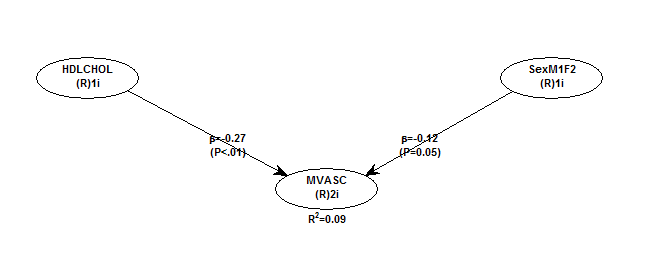
As mentioned before, total cholesterol is strongly influenced by HDL cholesterol, so below is the model with only HDL cholesterol (HDLCHOL) pointing at mortality from all cardiovascular diseases (MVASC), and the control variable sex (SexM1F2).


The graph above confirms the assumption that HDL’s protective role is subsumed by the variable total cholesterol. When the variable total cholesterol is removed from the model, as it was done above, the protective effect of HDL cholesterol becomes significant (beta=-0.27; P<0.01). The control variable sex (SexM1F2) was retained even in this targeted HDL effect model because of the expected confounding effect of sex; females generally tend to have higher HDL cholesterol and less cardiovascular disease than males.

Below, in the “Notes” section (after the “Reference”) are several notes, some of which are quite technical. Providing them separately hopefully has made the discussion above a bit easier to follow. The notes also point at some limitations of the analysis. This data needs to be analyzed from different angles, using multiple models, so that firmer conclusions can be reached. Still, the overall picture that seems to be emerging is at odds with previous beliefs based on the same dataset.

What could be increasing the apparently protective HDL and total cholesterol in this dataset? High consumption of animal foods, particularly foods rich in saturated fat and cholesterol, are strong candidates. Low consumption of vegetable oils rich in linoleic acid, and of foods rich in refined carbohydrates, are also good candidates. Maybe it is a combination of these.

We need more analyses!

Reference:

Kock, N. (2010). WarpPLS 1.0 User Manual. Laredo, Texas: ScriptWarp Systems.


Notes:

- The path coefficients (indicated as beta coefficients) reflect the strength of the relationships; they are a bit like standard univariate (or Pearson) correlation coefficients, except that they take into consideration multivariate relationships (they control for competing effects on each variable).

- The R-squared values reflect the percentage of explained variance for certain variables; the higher they are, the better the model fit with the data. In complex and multi-factorial phenomena such as health-related phenomena, many would consider an R-squared of 0.20 as acceptable. Still, such an R-squared would mean that 80 percent of the variance for a particularly variable is unexplained by the data.

- The P values have been calculated using a nonparametric technique, a form of resampling called jackknifing, which does not require the assumption that the data is normally distributed to be met. This and other related techniques also tend to yield more reliable results for small samples, and samples with outliers (as long as the outliers are “good” data, and are not the result of measurement error).

- Colinearity is an important consideration in models that analyze the effect of multiple predictors on one single variable. This is particularly true for multiple regression models, where there is a temptation of adding many predictors to the model to see which ones come out as the “winners”. This often backfires, as colinearity can severely distort the results. Some multiple regression techniques, such as automated stepwise regression with backward elimination, are particularly vulnerable to this problem. Colinearity is not the same as correlation, and thus is defined and measured differently. Two predictor variables may be significantly correlated and still have low colinearity. A reasonably reliable measure of colinearity is the variance inflation factor. Colinearity was tested in this model, and was found to be low.

- An effort was made here to avoid multiple data points per county (even though this was available for some variables), because this could artificially reduce the variance for each variable, and potentially bias the results. The reason for this is that multiple answers from a single county would normally be somewhat correlated; a higher degree of intra-county correlation than inter-county correlation. The resulting bias would be difficult to control for, via one or more control variables. With only two data points per county, one for males and the other for females, one can control for intra-country correlation by adding a “dummy” sex variable to the analysis, as a control variable. This was done here.

- Mortality from schistosomiasis infection (MSCHIST) is a variable that tends to affect the results in a way that makes it more difficult to make sense of them. Generally this is true for any infectious diseases that significantly affect a population under study. The problem with infection is that people with otherwise good health or habits may get the infection, and people with bad health and habits may not. Since cholesterol is used by the human body to fight disease, it may go up, giving the impression that it is going up for some other reason. Perhaps instead of controlling for its effect, as done here, it would have been better to remove from the analysis those counties with deaths from schistosomiasis infection. (See also this post, and this one.)

- Different parts of the data were collected at different times. It seems that the mortality data is for the period 1986-88, and the rest of the data is for 1989. This may have biased the results somewhat, even though the time lag is not that long, especially if there were changes in certain health trends from one period to the other. For example, major migrations from one county to another could have significantly affected the results.

- The following measures were used, from this online dataset like the other measures. P002 HDLCHOL, for HDLCHOL; P001 TOTCHOL, for TOTCHOL; and M021 SCHISTOc, for MSCHIST.

- SexM1F2 is a “dummy” variable that was coded with 1 assigned to males and 2 to females. As such, it essentially measures the “degree of femaleness” of the respondents. Being female is generally protective against cardiovascular disease, a situation that reverts itself a bit after menopause.

- MVASC is a composite measure of the two following variables, provided as component measures of mortality from all cardiovascular diseases: M058 ALLVASCb (ages 0-34), and M059 ALLVASCc (ages 35-69). A couple of obvious problems: (a) they does not include data on people older than 69; and (b) they seem to capture a lot of diseases, including some that do not seem like typical cardiovascular diseases. A factor analysis was conducted, and the loadings and cross-loadings suggested good validity. Composite reliability was also good. So essentially MVASC is measured here as a “latent variable” with two “indicators”. Why do this? The reason is that it reduces the biasing effects of incomplete data and measurement error (e.g., exclusion of folks older than 69). By the way, there is always some measurement error in any dataset.

- This note is related to measurement error in connection with the indicators for MVASC. There is something odd about the variables M058 ALLVASCb (ages 0-34), and M059 ALLVASCc (ages 35-69). According to the dataset, mortality from cardiovascular diseases for ages 0-34 is typically higher than for 35-69, for many counties. Given the good validity and reliability for MVASC as a latent variable, it is possible that the values for these two indicator variables were simply swapped by mistake.

May 27, 2010

Postprandial glucose levels, HbA1c, and arterial stiffness: Compared to glucose, lipids are not even on the radar screen

Postprandial glucose levels are the levels of blood glucose after meals. In Western urban environments, the main contributors to elevated postprandial glucose are foods rich in refined carbohydrates and sugars. While postprandial glucose levels may vary somewhat erratically, they are particularly elevated in the morning after breakfast. The main reason for this is that breakfast, in Western urban environments, is typically very high in refined carbohydrates and sugars.

HbA1c, or glycated hemoglobin, is a measure of average blood glucose over a period of a few months. Blood glucose glycates (i.e., sticks to) hemoglobin, a protein found in red blood cells. Red blood cells are relatively long-lived, lasting approximately 3 months. Thus HbA1c (given in percentages) is a good indicator of average blood glucose levels, if you don’t suffer from anemia or a few other blood abnormalities.

Based on HbA1c, one can then estimate his or her average blood glucose level for the previous 3 months or so before the test, using one of the following equations, depending on whether the measurement is in mg/dl or mmol/l.

Average blood glucose (mg/dl) = 28.7 × HbA1c − 46.7
Average blood glucose (mmol/l) = 1.59 × HbA1c − 2.59

Elevated blood glucose levels cause damage in the body primarily through glycation, which leads to the formation of advanced glycation endproducts (AGEs). Given this, HbA1c can be seen as a proxy for the level of damage done by elevated blood glucose levels to various body tissues. This damage occurs over time; often after many years of high blood glucose levels. It includes kidney damage, neurological damage, cardiovascular damage, and damage to the retina.

Most regular blood exams focus on fasting blood glucose as a measure of glucose metabolism status. Many medical practitioners have as a target a fasting blood glucose level of 125 mg/dl (7 mmol/l) or less, and largely disregard postprandial glucose levels or HbA1c in their management of glucose metabolism. Leiter and colleagues (2005; full reference at the end of this post) showed that this focus on fasting blood glucose is a mistake. They are not alone; many others made this point, including some very knowledgeable bloggers who focus on diabetes (see “Interesting links” section of this blog). Leiter and colleagues (2005) also provided some interesting graphs and figures, including eye-opening correlations between various variables and arterial stiffness. The figure below (click to enlarge) shows the contribution of postprandial glucose to HbA1c.


Note that the lower the HbA1c is in the figure (horizontal axis), the higher is the postprandial glucose contribution to HbA1c. And, the lower the HbA1c, the closer the individuals are to what one could consider having a perfectly normal HbA1c level (around 5 percent). That is, only for individuals whose HbA1c levels are very high, fasting blood glucose levels are relatively reliable measures of the tissue damage done be elevated blood glucose levels.

The table below (click to enlarge) shows P values associated with the impact of various variables (listed on the leftmost column) on arterial stiffness. This measure, arterial stiffness, is strongly associated with an increased risk of cardiovascular events. Look at the middle column showing P values adjusted for age and height. The lower the P value, the more a variable affects arterial stiffness. The variable with the lowest P value by far is 2-hour postprandial blood glucose; the blood glucose levels measured 2 hours after meals.


Fasting glucose levels were reported to be statistically insignificant because of the P = 0.049, in terms of their effect on arterial stiffness, but this P value is actually significant, although barely, at the 0.05 level (95 percent confidence). Interestingly, the following measures are not even on the radar screen, as far as arterial stiffness is concerned: systolic blood pressure, LDL cholesterol, HDL cholesterol, triglycerides, and fasting insulin levels.

What about the lipid hypothesis, and the “bad” LDL cholesterol!? This study is telling us that these are not very relevant for arterial stiffness when we control for the effect of blood glucose measures. Not even fasting insulin levels matters much! Wait, not even HDL!!! A high HDL has been definitely shown to be protective, but when we look at the relative magnitude of various effects, the story is a bit different. A high HDL’s protective effect exists, but it is dwarfed by the negative effect of high blood glucose levels, especially after meals, in the context of cardiovascular disease.

What all this points at is what we could call a postprandial glucose hypothesis: Lower your postprandial glucose levels, and live a longer, healthier life! And, by the way, if your postprandial glucose levels are under control, lipids do not matter much! Or maybe your lipids will fall into place, without any need for statin drugs, after your postprandial glucose levels are under control. One way or another, the outcome will be a positive one. That is what the data from this study is telling us.

How do you lower your postprandial glucose levels?

A good way to start is to remove foods rich in refined carbohydrates and sugars from your diet. Almost all of these are foods engineered by humans with the goal of being addictive; they usually come in boxes and brightly colored plastic wraps. They are not hard to miss. They are typically in the central aisles of supermarkets. The sooner you remove them from your diet, the better. The more completely you do this, the better.

Note that the evidence discussed in this post is in connection with blood glucose levels, not glucose metabolism per se. If you have impaired glucose metabolism (e.g., diabetes type 2), you can still avoid a lot of problems if you effectively control your blood glucose levels. You may have to be a bit more aggressive, adding low carbohydrate dieting (as in the Atkins or Optimal diets) to the removal of refined carbohydrates and sugars from your diet; the latter is in many ways similar to adopting a Paleolithic diet. You may have to take some drugs, such as Metformin (a.k.a. Glucophage). But you are certainly not doomed if you are diabetic.

Reference:

Leiter, L.A., Ceriello, A., Davidson, J.A., Hanefeld, M., Monnier, L., Owens, D.R., Tajima, N., & Tuomilehto, J. (2005). Postprandial glucose regulation: New data and new implications. Clinical Therapeutics, 27(2), S42-S56.

May 7, 2010

Niacin and its effects on growth hormone, glucagon, cortisol, blood lipids, mental disorders, and fasting glucose levels

Niacin is a very interesting vitamin. It is also known as vitamin B3, or nicotinic acid. It is an essential vitamin whose deficiency leads to a dreadful disease known as pellagra. In large doses of 1 to 3 g per day it has several effects on blood lipids, including these: it increases HDL cholesterol, decreases triglycerides, and decreases Lp(a). Given that this is essentially a reversal of the metabolic syndrome, for those who are on their way to developing it, niacin must really do something good for our body. Niacin is also a powerful antioxidant.

The lipid modification effects of niacin are so consistent across a broad spectrum of the population that some companies that commercialize niacin-based products guarantee some measure of those effects. The graphs below (click to enlarge) are from Arizona Pharmaceuticals, a company that commercializes an instant-release niacin formulation called Nialor (see: arizonapharmaceuticals.com). The graphs show the peak effects on HDL cholesterol and triglycerides at the recommended dose, which is 1.5 g per day. The company guarantees effects; not the peak effects shown, but effects that are large enough to have clinical significance.


Niacin also has been used in the treatment of various mental disorders, including schizophrenia. Its effectiveness in this domain (mental disease) is still under debate. Yet many people, including reputable mental health researchers, swear by it. Empirical research suggests beyond much doubt that niacin helps in the treatment of depression and bipolar disorder.

Abram Hoffer, a Canadian psychiatrist who died in 2009, at the age of 91, has discussed at length the many beneficial health effects of niacin. He was also a niacin user. He argued that it can even make people live longer, and be generally healthier and more active. The effect on longevity may sound far-fetched, but there is empirical data supporting this hypothesis as well. (For more, see this book.)

By the way, moderate niacin supplementation seems to increase the milk output of cows, without any effect on milk composition.

Most people dislike the sensation that is caused by niacin, the “niacin flush”. This is a temporary sensation similar to that of sunburn covering one’s full torso and face. It goes away after a few minutes. This is niacin’s main undesirable side effect at doses up to 3 g per day. Higher doses are not recommended, and can be toxic to the liver.

Nobody seems to understand very well how niacin works. This leads to some confusion. Many people think that niacin inhibits the production of VLDL, free fatty acids, and ketones; preventing the use of fat as an energy source. And it does!

So it makes you fat, right?

No, because these effects are temporary, and are followed, often after 3 to 5 hours, by a large increase in circulating growth hormone, cortisol and glucagon. These hormones are associated with (maybe they cause, maybe are caused by) a large increase in free fatty acids and ketones in circulation, but not with an increase in VLDL secretion by the liver. So ketosis is at first inhibited by niacin, and then comes in full force after a few hours.

The decreased VLDL secretion is no surprise, because VLDL is not really needed in large quantities if muscle tissues (including the heart) are being fed what they really like: free fatty acids and ketones. When VLDL particles are secreted by the liver in small numbers, they tend to be large. As they shrink in size after delivering their lipid content to muscle tissues, they become large LDL particles; too large to cross the endothelial gaps and cause plaque formation.

It is as if niacin held you back for a few hours, in terms of fat burning, and then released you with a strong push.

Since niacin does not seem to suppress the secretion of chylomicrons by the intestines, it should be taken with meals. The meals do not necessarily have to have any carbohydrates in them. If you take niacin while fasting, you may feel “funny” and somewhat weak, because of the decrease in VLDL, free fatty acids, and ketones in circulation. These, particularly the free fatty acids and ketones, are important sources of energy in the fasted state.

Given niacin’s delayed effects, it does not seem to make much sense to take slow release niacin of any kind. In fact, the form of niacin that seems to work best is the instant-release one, the one that gives you the flush. It may be a good idea to wait until 3 to 5 hours after you take it to do heavy exercise. You may feel a surge of energy 3 to 5 hours after taking it, when the delayed effects kick in.

The delayed effects of niacin on growth hormone, cortisol and glucagon are probably the reasons why people taking niacin frequently see a small increase in fasting glucose levels. This increase is usually of a few percentage points, but can be a bit higher in some people. Growth hormone, cortisol and particularly glucagon increase blood glucose levels; and the blood levels of these hormones naturally rise in the morning to get you ready for the day ahead. Niacin seems to boost that. Hence the increase in fasting blood glucose levels. This appears to be a benign effect, easily counterbalanced by niacin’s many benefits.

In spite of a possible increase in fasting glucose levels, there is no evidence that niacin increases average blood glucose levels. If it did, that would not be a good thing. In fact, it has been argued that niacin intake can be part of an effective approach to treating diabetes; Robert C. Atkins discussed this in his Vita-Nutrient Solution book.

Niacin’s effects on lipids are somewhat similar to those of low carbohydrate dieting. For example, both lead to a decrease in fasting triglycerides and an increase in HDL cholesterol. But the mechanisms by which those effects are achieved appear to be rather different.

References:

Quabbe, H.J., Trompke, M., & Luyckx, A.S. (1983). Influence of ketone body infusion on plasma growth hormone and glucagon in man. J. Clin Endocrinol Metab., 57(3):613-8.

Quabbe, H.J., Luyckx, A.S., L'age M., & Schwarz, C. (1983). Growth hormone, cortisol, and glucagon concentrations during plasma free fatty acid depression: different effects of nicotinic acid and an adenosine derivative (BM 11.189). J. Clin Endocrinol Metab., 57(2):410-4.

Schade, D.S., Woodside, W., & Eaton, R.P. (1979). The role of glucagon in the regulation of plasma lipids. Metabolism, 28(8):874-86.

April 6, 2010

Low fasting triglycerides: A marker for large-buoyant LDL particles

Small-dense LDL particles are particles that are significantly smaller than the gaps in the endothelium. The endothelium is a thin layer of cells that line the interior of arteries. Those gaps are about 25-26 nanometers (nm) in diameter. Small-dense LDL particles can contribute a lot more to the formation of atheromas (atherosclerotic plaques) in predisposed individuals than large-buoyant LDL particles.

Note that typically LDL particles are about 23-25 nm in diameter in most people, and yet not everybody develops atheromas. It is illogical to believe that evolution made LDL particles within those ranges of size to harm us, given the size of the gaps in the endothelium, unless you believe in something like this joke theory. There are underlying factors that make individuals much more prone to the development of atheromas than others.

One of those factors is chronic inflammation, which is caused by: chronic stress, excessive exercise (aerobic or anaerobic), and a diet rich in refined carbohydrates (e.g., white bread, pasta) and refined sugars (e.g., high fructose corn syrup, table sugar).

Can a standard lipid profile report tell me anything about my LDL particle pattern?

Yes, check you fasting triglycerides. If they are below 70 mg/dL, it is very likely that you have a predominance of large-buoyant LDL particles in your blood. That is, your LDL particle pattern is most likely Pattern A (see figure below, from: www.degomamd.com), the least atherogenic of the patterns identified by a Vertical Auto Profile (VAP) test. This test is more sophisticated than a standard lipid profile test, where the LDL cholesterol is typically calculated. For a sample VAP test report, see this PDF file from Atherotech.


So, you can get a rough idea about your LDL pattern type only by checking your fasting triglyceride levels on a standard lipid profile test report, if you cannot or do not want to have a VAP test done. The higher your fasting triglyceride levels are, above 70, the more likely it is that your LDL particle pattern is Pattern B, which is the most potentially atherogenic pattern.

Large-buoyant LDL particles often lead to high measured LDL cholesterol levels. This situation is analogous to that of water-filled balloons. If you have 10 balloons, each holding 0.5 L of water, then your total water amount is 5 L. If the same balloons are filled with 1 L of water each, then your total water amount is 10 L. That is, even though the number of LDL particles (analogous to the number of balloons) may be the same as that of a person with low LDL cholesterol, large-buoyant LDL particles have more cholesterol (water content in each balloon) in them, and lead to higher measured LDL cholesterol (total amount of water in the balloons) levels.

This leads to the counterintuitive situation where your LDL cholesterol levels go up, and your risk of developing cardiovascular disease actually goes down.

Also worth keeping in mind is that fasting triglyceride levels are strongly and negatively correlated with HDL cholesterol levels. The higher your fasting triglyceride levels are, usually the lower are your HDL cholesterol levels. The latter are also provided in standard lipid profile reports.

How do you decrease your fasting triglycerides?

A good way to start is to do some of the things that increase your HDL cholesterol.

References:

Elliott, W.H., & Elliott, D.C. (2009). Biochemistry and molecular biology. 4th Edition. New York: NY: Oxford University Press.

Lemanski, P.E. (2004). Beyond routine cholesterol testing: The role of LDL particle size assessment. CDPHP Medical Messenger, May 2004.

March 28, 2010

LDL, chylomicrons, HDL, and atherosclerosis: A lazy Sunday theory

Notes:
  - This post is a joke, admittedly a weird one, which is why it is labeled “humor” and is filed under “Abstract humor”.
  - I apologize for this spoiler. Some people probably like humor posts better if they do not know what they are in advance, but several others may think that reading a post like this is a waste of their time. If you are in the latter category, move on to another post! If not, here it goes …

***

Today I was spending some time under the sun, in one of the year’s 364 sunny days in Laredo, Texas. The goal was to see if I could obtain a precise count of the number of advanced glycation endproducts (a.k.a. AGEs) that would form as my skin was exposed to the sun’s damaging rays.

Then I read a post by Peter at Hyperlipid, and inspiration consumed me. A new theory was born regarding the interplay of LDL, chylomicrons, HDL, and atherosclerosis. By the way, Peter is a fat genius, by which I mean a genius regarding all fat issues – who happens to be thin.

A key observation forms the main pillar on which this new theory solidly rests:

The endothelium gaps, which let atherogenic particles enter into the forbidden area and do their damage, are around 25 nanometers in diameter. And what is the typical size of LDL particles? You guessed it, 25 nanometers in diameter! And guess what more, quite a few of the chylomicrons, another group of particles that would elicit immediate revulsion in any normal human being, are even smaller than 25 nanometers in diameter; those atherogenic pests!

So here is the theory, in a nutshell. A 500-page book will clearly be needed to discuss it in more detail.

The Devil created LDL particles to kill us all. But LDL particles were not such effective killers, because the Devil, trying to pack as much killer cholesterol into them, ended up making them too big! At 25 nanometers in diameter, on average, they basically had to squeeze their way into the forbidden area.

Since LDL particles were not doing a good enough job, the Devil also created chylomicrons, and those chaotic pests come in all sizes. In fact, it is well known that the word chylomicron has a Greek origin: chylo = killer, micron = particle (Deth & Disis, 1999; full reference at the end of this post).

And, needless to say, LDL particles and chylomicrons are fat particles that make the blood kind of taste and smell like butter, a toxic substance often fed to laboratory rats and known for its powerful carcinogenic properties among all living creatures except descendants of Vlad the Impaler. The latter has long been rumored to have been one of the Devil's best buddies, so no surprise there.

Michael the Archangel, who dislikes the Devil, and usually takes a hands-on approach to dealing with those he dislikes, the Devil in particular, gave us HDL particles. If you have any doubts about Michael’s hands-on approach, check the picture below (from: Wikipedia), which clearly shows what Michael had already done to the Devil. And that was over a relatively minor disagreement.


And don’t think about trying to discredit this theory by asking why HDL particles are so small compared with LDL particles and chylomicrons! This is easy. For the same reason that David was small and Goliath big!

But those nasty particles, the LDLs and chylomicrons, weren't only two big bullies, they were two against one. HDL particles were doing a valiant job at fighting the damage done by the Devil’s two evil particles, but not quite enough to save everybody from atherosclerosis.

Michael cried foul, and threatened to give the Devil another lesson. God, seeing this, said: Michael, no, mankind must be given a choice! If men and women want to gorge on the fatty flesh of the beasts they savagely slaughter, let them sin and face the consequences.

And so it was.

This theory probably needs some adjustments and refinements based on analysis of refereed research, especially solid research supported by drug manufacturers, and consultation with the most interesting man in the world. But I am pretty confident it can, after adjustments and refinements, pass the test of time.

The only nagging problem is the Original Sin. To the best of my knowledge, it was not eating the fatty flesh of beasts. It was eating a very sweet apple …

Reference:

Deth, R., & Disis, M. (1999, Feb 31). The origins of killer lipids: An evolutionary-theological perspective. The Lipid Review, 123(7), 77-66.

February 20, 2010

What should be my HDL cholesterol?

HDL cholesterol levels are a rough measure of HDL particle quantity in the blood. They actually tell us next to nothing about HDL particle type, although HDL cholesterol increases are usually associated with increases in LDL particle size. This a good thing, since small-dense LDL particles are associated with increased cardiovascular disease.

Most blood lipid panels reviewed by family doctors with patients give information about HDL status through measures of HDL cholesterol, provided in one of the standard units (e.g., mg/dl).

Study after study shows that HDL cholesterol levels, although imprecise, are a much better predictor of cardiovascular disease than LDL or total cholesterol levels. How high should be one’s HDL cholesterol? The answer to this question is somewhat dependent on each individual’s health profile, but most data suggest that a level greater than 60 mg/dl (1.55 mmol/l) is close to optimal for most people.

The figure below (from Eckardstein, 2008; full reference at the end of this post) plots incidence of coronary events in men (on the vertical axis), over a period of 10 years, against HDL cholesterol levels (on the horizontal axis). Note: IFG = impaired fasting glucose. This relationship is similar for women, particularly post-menopausal women. Pre-menopausal women usually have higher HDL cholesterol levels than men, and a low incidence of coronary events.


From the figure above, one can say that a diabetic man with about 55 mg/dl of HDL cholesterol will have approximately the same chance, on average, of having a coronary event (a heart attack) as a man with no risk factors and about 20 mg/dl of HDL cholesterol. That chance will be about 7 percent. With 20 mg/dl of HDL cholesterol, the chance of a diabetic man having a coronary event would approach 50 percent.

We can also conclude from the figure above that a man with no risk factors will have a 5 percent chance of having a coronary event if his HDL cholesterol is about 25 mg/dl; and about 2 percent if his HDL cholesterol is greater than 60 mg/dl. This a 60 percent reduction in risk, a risk that was low to start with because of the absence of risk factors.

HDL cholesterol levels greater than 60 are associated with significantly reduced risks of coronary events, particularly for those with diabetes (the graph does not take diabetes type into consideration). Much higher levels of HDL cholesterol (beyond 60) do not seem to be associated with much lower risk of coronary events.

Conversely, a very low HDL cholesterol level (below 25) is a major risk factor when other risk factors are also present, particularly: diabetes, hypertension (high blood pressure), and familial hypercholesteromia (gene-induced very elevated LDL cholesterol).

It is not yet clear whether HDL cholesterol is a cause of reduced cardiovascular disease, or just a marker of other health factors that lead to reduced risk for cardiovascular disease. Much of the empirical evidence suggests a causal relationship, and if this is the case then it may be a good idea to try to increase HDL levels. Even if HDL cholesterol is just a marker, the same strategy that increases it may also have a positive impact on the real causative factor of which HDL cholesterol is a marker.

What can one do to increase his or her HDL cholesterol? One way is to replace refined carbs and sugars with saturated fat and cholesterol in one’s diet. (I know that this sounds counterintuitive, but seems to work.) Another is to increase one’s vitamin D status, through sun exposure or supplementation.

Other therapeutic interventions can also be used to increase HDL; some more natural than others. The figure below (also from Eckardstein, 2008) shows the maximum effects of several therapeutic interventions to increase HDL cholesterol.


Among the therapeutic interventions shown in the figure above, taking nicotinic acid (niacin) in pharmacological doses, of 1 to 3 g per day (higher dosages may be toxic), is by far the most effective way of increasing one’s HDL cholesterol. Only the niacin that causes flush is effective in this respect. No-flush niacin preparations may have some anti-inflammatory effects, but do not cause increases in HDL cholesterol.

Rimonabant, which is second to niacin in its effect on HDL cholesterol, is an appetite suppressor that has been associated with serious side effects and, to be best of my knowledge, has been largely banned from use in pharmaceutical drugs.

Third in terms of effectiveness, among the factors shown in the figure, is moderate alcohol consumption. Running about 19 miles per week (2.7 miles per day) and taking fibrates are tied in forth place.

Many people think that they are having a major allergic reaction, and have a panic attack, when they experience the niacin flush. This usually happens several minutes after taking niacin, and depends on the dose and whether niacin was consumed with food or not. It is not uncommon for one’s entire torso to turn hot red, as though the person had had major sunburn. This reaction is harmless, and usually disappears after several minutes.

One could say that, with niacin: no “pain” (i.e., flush), no gain.

Reference:

von Eckardstein, A. (2008). HDL – a difficult friend. Drug Discovery Today: Disease Mechanisms, 5(3), 315-324.

February 16, 2010

Large LDL and small HDL particles: The best combination

High-density lipoprotein (HDL) is one of the five main types of lipoproteins found in circulation, together with very low-density lipoprotein (VLDL), intermediate-density lipoprotein (IDL), low-density lipoprotein (LDL), and chylomicrons.

After a fatty meal, the blood is filled with chylomicrons, which carry triglycerides (TGAs). The TGAs are transferred to cells from chylomicrons via the activity of enzymes, in the form of free fatty acids (FFAs), which are used by those cells as sources of energy.

After delivering FFAs to the cells, the chylomicrons progressively lose their TGA content and “shrink”, eventually being absorbed and recycled by the liver. The liver exports part of the TGAs that it gets from chylomicrons back to cells for use as energy as well, now in the form of VLDL. As VLDL particles deliver TGAs to the cells they shrink in size, similarly to chylomicrons. As they shrink, VLDL particles first become IDL and then LDL particles.

The figure below (click on it to enlarge), from Elliott & Elliott (2009; reference at the end of this post), shows, on the same scale: (a) VLDL particles, (b) chylomicrons, (c) LDL particles, and (d) HDL particles. The dark bar at the bottom of each shot is 1000 A in length, or 100 nm (A = angstrom; nm = nanometer; 1 nm = 10 A).


As you can see from the figure, most of the LDL particles shown are about 1/4 of the length of the dark bar in diameter, often slightly more, or about 25-27 nm in size. They come in different sizes, with sizes in this range  being the most common. The smaller and denser they are, the more likely they are to contribute to the formation of atherosclerotic plaque in the presence of other factors, such as chronic inflammation. The larger they become, which usually happens in diets high in saturated fat, the less likely they are to form plaque.

Note that the HDL particles are rather small compared to the LDL particles. Shouldn’t they cause plaque then? Not really. Apparently they have to be small, compared to LDL particles, to do their job effectively.

HDL is a completely different animal from VLDL, IDL and LDL. HDL particles are produced by the liver as dense disk-like particles, known as nascent HDL particles. These nascent HDL particles progressively pick up cholesterol from cells, as well as performing a number of other functions, and “fatten up” with cholesterol in the process.

This process also involves HDL particles picking up cholesterol from plaque in the artery walls, which is one of the reasons why HDL cholesterol is informally called “good” cholesterol. In fact, neither HDL nor LDL are really cholesterol; HDL and LDL are particles that carry cholesterol, protein and fat.

As far as particle size is concerned, LDL and HDL are opposites. Large LDL particles are the least likely to cause plaque formation, because LDL particles have to be approximately 25 nm in diameter or smaller to penetrate the artery walls. With HDL the opposite seems to be true, as HDL particles need to be small (compared with LDL particles) to easily penetrate the artery walls in order to pick up cholesterol, leave the artery walls with their cargo, and have it returned back to the liver.

Interestingly, some research suggests HDL particles that are larger in size, when compared with other HDL particles (not with LDL particles), seem to do a better job than very small HDL particles in terms of reducing risk of cardiovascular disease. It is also possible that a high number of larger HDL particles in the blood is indicative of elevated levels of "effective" HDL particles; i.e., particles that are effective at picking up cholesterol from the artery walls in the first place.

Another interesting aspect of this cycle is that the return to the liver of cholesterol picked up by HDL appears to be done largely via IDL and LDL particles (Elliott & Elliott, 2009), which get the cholesterol directly from HDL particles! Life is not that simple.

Reference:

William H. Elliott & Daphne C. Elliott (2009). Biochemistry and Molecular Biology. 4th Edition. New York: NY: Oxford University Press.

February 13, 2010

Want to improve your cholesterol profile? Replace refined carbs and sugars with saturated fat and cholesterol in your diet

An interesting study by Clifton and colleagues (1998; full reference and link at the end of this post) looked at whether LDL cholesterol particle size distribution at baseline (i.e., beginning of the study) for various people was a determinant of lipid profile changes in each of two diets – one low and the other high in fat. This study highlights a few interesting points made in a previous post, which are largely unrelated to the main goal or findings of the study, but that are supported by side findings:

- As one increases dietary cholesterol and fat consumption, particularly saturated fat, circulating HDL cholesterol increases significantly. This happens whether one is taking niacin or not, although niacin seems to help, possibly as an independent (not moderating) factor. Increasing serum vitamin D levels, which can be done through sunlight exposure and supplementation, are also known to increase circulating HDL cholesterol.

- As one increases dietary cholesterol and fat consumption, particularly saturated fat, triglycerides in the fasting state (i.e., measured after a 8-hour fast) decrease significantly, particularly on a low carbohydrate diet. Triglycerides in the fasting state are negatively correlated with HDL cholesterol; they go down as HDL cholesterol goes up. This happens whether one is taking niacin or supplementing omega 3 fats or not, although these seem to help, possibly as independent factors.

- If one increases dietary fat intake, without also decreasing carbohydrate intake (particularly in the form of refined grains and sugars), LDL cholesterol will increase. Even so, LDL particle sizes will shift to more benign forms, which are the larger forms. Not all LDL particles change to benign forms, and there seem to be some genetic factors that influence this. LDL particles larger than 26 nm in diameter simply cannot pass through the gaps in the endothelium, which is a thin layer of cells lining the interior surface of arteries, and thus do not induce plaque formation.

The study by Clifton and colleagues (1998) involved 54 men and 51 women with a wide range of lipid profiles. They first underwent a 2-week low fat period, after which they were given two liquid supplements in addition to their low fat diet, for a period of 3 weeks. One of the liquid supplements contained 31 to 40 g of fat, and 650 to 845 mg of cholesterol. The other was fat and cholesterol free.

Studies that adopt a particular diet at baseline have the advantage of departing from a uniform diet across conditions. They also typically have one common characteristic: the baseline diet reflects the beliefs of the authors about what an ideal diet is. That is not always the case, of course. If this was indeed the case here, we have a particularly interesting study, because in that case the side findings discussed below contradicted the authors’ beliefs.

The table below shows the following measures for the participants in the study: age, body mass index (BMI), waist-to-hip ratio (WHR), total cholesterol, triglycerides, low-density lipoprotein (LDL) cholesterol, and three subtypes of high-density lipoprotein (HDL) cholesterol. LDL cholesterol is the colloquially known as the “bad” type, and “HDL” as the good one (which is an oversimplification). In short, the participants were overweight, middle-aged men and women, with relatively poor lipid profiles.


At the bottom of the table is the note “P < 0.001”, following a small “a”. This essentially means that on the rows indicated by an “a”, like the “WHR” row, the difference in the averages (e.g., 0.81 for women, and 0.93 for men, in the WHR row) was significantly different from what one would expect it to be due to chance alone. More precisely, the likelihood that the difference was due to chance was lower than 0.001, or 0.1 percent, in the case of a P < 0.001. Usually a difference between averages (a.k.a. means) associated with a P < 0.05 will be considered statistically significant.

Since the LDL cholesterol concentrations (as well as other lipoprotein concentrations) are listed on the table in mmol/L, and many people receive those measures in mg/dL in blood lipid profile test reports, below is a conversion table for LDL cholesterol (from: Wikipedia).


The table below shows the dietary intake in the low and high fat diets. Note that in the high fat diet, not only is the fat intake higher, but so is the cholesterol intake. The latter is significantly higher, more than 4 times the intake in the low fat diet, and about 2.5 times the recommended daily value by the U.S. Food and Drug Administration. The total calorie intake is reported as slightly lower in the high fat diet than in the low fat diet.


Note that the largest increase was in saturated fat, followed by an almost equally large increase in monounsaturated fat. This, together with the increase in cholesterol, mimics a move to a diet where fatty meat and organs are consumed in higher quantities, with a corresponding reduction in the intake of refined carbohydrates (e.g., bread, pasta, sugar, potatoes) and lean meats.

Finally, the table below shows the changes in lipid profiles in the low and high fat diets. Note that all subtypes of HDL (or "good") cholesterol concentrations were significantly higher in the high fat diet, which is very telling, because HDL cholesterol concentrations are much better predictors of cardiovascular disease than LDL or total cholesterol concentrations. The higher the HDL cholesterol, the lower the risk of cardiovascular disease.


In the table above, we also see that triglycerides are significantly lower in the high fat diet, which is also good, because high fasting triglyceride concentrations are associated with cardiovascular disease and also insulin resistance (which is associated with diabetes).

However, the total and LDL cholesterol were also significantly higher in the high fat compared to the low fat diet. Is this as bad as it sounds? Not when we look at other factors that are not clear from the tables in the article.

One of those factors is the likely change in LDL particle size. LDL particle sizes almost always increase with significant increases in HDL; frequently going up in diameter beyond 26 nm, and thus passing the threshold beyond which an LDL particle can penetrate the endothelium and help form a plaque.

Another important factor to take into consideration is the somewhat strange decision by the authors to use the Friedewald equation to estimate the LDL concentrations in the low and high fat diets. Through the Friedewald equation, LDL is calculated as follows (where TC is total cholesterol):

    LDL = TC – HDL – Triglycerides / 5

Here is one of the problems with the Friedewald equation. Let us assume that an individual has the following lipid profile numbers: TC = 200, HDL = 50, and trigs. = 150. The calculated LDL will be 120. Let us assume that this same individual reduces trigs. to 50, from the previous 150, keeping all of the other measures constant. This is a major improvement. Yet, the calculated LDL will now be 140, and a doctor will tell this person to consider taking statins!

By the way, most people who do a blood test and get their lipid profile report also get their LDL calculated through the Friedewald equation. Usually this is indicated through a "CALC" note next to the description of the test or the calculated LDL number.

Finally, total cholesterol is not a very useful measure, because an elevated total cholesterol may be primarily reflecting an elevated HDL, which is healthy. Also, a slightly elevated total cholesterol seems to be protective, as it is associated with reduced overall mortality and also reduced mortality from cardiovascular disease, according to U-curve regression studies comparing mortality and total cholesterol levels in different countries.

We do not know for sure that the participants in this study were consuming a lot of refined carbohydrates and/or sugars at baseline. But it is a safe bet that they were, since they were consuming 214 g of carbohydrates per day. It is difficult, although not impossible, to eat that many carbohydrates per day by eating only vegetables and fruits, which are mostly water. Consumption of starches makes it easier to reach that level.

This is why when one goes on a paleo diet, he or she reduces significantly the amount of dietary carbohydrates; even more so on a targeted low carbohydrate diet, such as the Atkins diet. Richard K. Bernstein, who is a type 1 diabetic and has been adopting a strict low carbohydrate diet during most of his adult life, had the following lipid profile at 72 years of age: HDL = 118, LDL = 53, trigs. = 45. His fasting blood sugar was reportedly 83 mg/dl. Click here to listen to an interview with Dr. Bernstein on the The Livin' La Vida Low-Carb Show.

The lipid profile improvement observed (e.g., a 14 percent increase in HDL from baseline for men, and about half that for women, in only 3 weeks) was very likely due to an increase in dietary saturated fat and cholesterol combined with a decrease in refined carbohydrates and sugars. The improvement would probably have been even more impressive with a higher increase in saturated fat, as long as it was accompanied by the elimination of refined carbohydrates and sugars from the participants’ diets.

Reference:

Clifton, P. M., M. Noakes, and P. J. Nestel (1998). LDL particle size and LDL and HDL cholesterol changes with dietary fat and cholesterol in healthy subjects. J. Lipid. Res. 39: 1799–1804.

December 23, 2009

Half-hearted Atkins diet and cardiovascular disease

I would like to comment on a recent article comparing the Atkins, Ornish and South Beach diets (Miller et al., 2009; full reference at the end of this posting), which has been causing quite a lot of commotion among bloggers recently. Especially low carb. bloggers.

An excellent post by Michael Eades clarifies a number of issues with the study, including what one could argue is the study's main flaw. Apparently the study compared a half-hearted Atkins diet, with probably equally half-hearted Ornish and South Beach diets.

I refer to the study's Atkins diet as half-hearted because it seems to rely on a daily consumption of between 120 and 180 grams of carbohydrates. This is unlikely to lead to ketosis, the cornerstone of the Atkins diet, where the body uses ketone bodies (made from dietary as well as body fat) as a source of energy.

As I see it, the main findings of the study were that the participants in the half-hearted Atkins diet, after a period of 4 weeks on the diet, and when compared with the participants in the other diets, had: (a) greater levels of total cholesterol and LDL cholesterol, with only a small improvement in their HDL cholesterol and triglycerides levels; and (b) greater levels of markers for inflammation (e.g., C-reactive protein).

The participants were young and healthy. Their average age was 30.6 years, and their average body mass index was 22.6. On average, their total cholesterol was 184.9 mg/dL, triglycerides were 78.1 mg/dL, LDL cholesterol was 107.2 mg/dL, and HDL cholesterol was 62.2 mg/dL. These are arguably fairly healthy numbers; although quite a few doctors might want to put most of these folks preventively on statins because of their LDL being greater than 100.

What I find interesting about this study, and consistent with both my own experience and also a theory that I have, is that it suggests that a low carb. diet has to really be low carb. in order to bring about the benefits that one normally sees as a result of a diet that induces ketosis. A diet with, say, > 150 g of refined grains per day, is not really a low carb. diet.

Again, in my experience, and that of many other people, a truly low carb. diet (very low in, if not devoid of, refined carbs and sugars), will lead to an impressive increase in HDL cholesterol (especially for those who have low HDL to start with), an equally impressive decrease in triglycerides, increased insulin sensitivity, and possibly a decrease in LDL.

However, a half-hearted Atkins diet may actually lead to elevated LDL (of the small-dense type), and more inflammation, just like this study suggests it does, without the benefits regarding HDL and trigs. The reason is that the still relatively high level of carbohydrate intake, especially if it comes in the form of refined carbs. and sugars, will lead to higher levels of insulin being secreted into the bloodstream. This will promote increased body fat deposition. The extra saturated fat being consumed will be turned into body fat, and not used as energy, starving the cells and leading to increased hunger.

A diet rich in saturated fat may indeed be bad when it is also a diet even moderately rich in insulin-boosting, easily digestible carbs. This may be one of the main reasons why there have been so many studies in the past showing a correlation between saturated fat consumption and heart disease; studies that typically did not control for carbohydrate consumption.

In a recent interview on the Livin' La Vida Low-Carb Blog, Dr. John Salerno goes into more detail regarding this issue, recommending a much more rigid adoption of the Atkins diet than many think is okay. (In fact, I often talk to people who think that if they cut a very high carb. intake in half - e.g., from 400 to 200 grams per day - replacing the carbs with fat, they will be halfway into a full blown Atkins diet.) Dr. Salerno has worked in the past with Dr. Atkins. He calls his diet the Silver Cloud Diet. I am not sure I agree with all that Dr. Salerno had to say, but his argument in favor of a diet very low in carbs. does make sense to me.

Finally, I think that it is dangerous to extrapolate the results of any study, no matter how comprehensive, to the population in general. Each individual is unique in terms of his or her genetic makeup and life history; the latter also influences metabolic patterns. (Even identical twins raised together may display different metabolic patterns, because of their different life histories.)  So, while a low carb. diet may work well for a lot of people, it may have very negative effects on a few. Increases in inflammation markers and adverse effects on LDL cholesterol (especially when LDL is measured directly, accounting for particle numbers and sizes) are warning signs that any low carb. dieter should pay attention to.

Reference:

Miller, M. et al. (2009). Comparative effects of three popular diets on lipids, endothelial function, and c-reactive protein during weight maintenance. Journal of the American Dietetic Association, 109, 713-717.